
What’s the difference and why it matters
In today’s retail media and digital out-of-home ecosystems, understanding the distinction between endemic, near-endemic, and non-endemic advertising is essential. The difference is not just in name – it directly impacts campaign strategy, shopper psychology, and commercial outcomes.
What is endemic advertising?
Endemic advertising promotes products or brands that can be purchased directly at the retailer or venue where the advertising appears. The messaging aligns with the retailer’s assortment and is expected as part of the shopping experience.

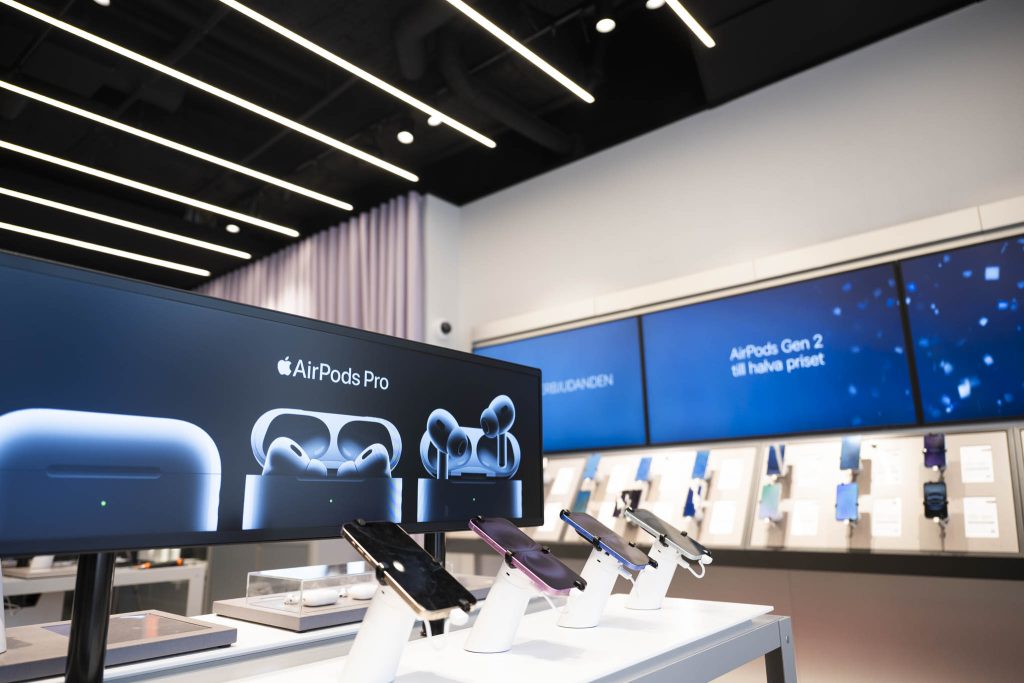
A sportswear brand inside a sporting goods store. A beverage in a convenience retailer. A travel accessory within an airport store.
Because the product is available for immediate purchase, endemic advertising integrates seamlessly into the customer journey. It reinforces intent and supports category conversion rather than interrupting it.
What is near-endemic advertising?
Near-endemic advertising promotes products or services not sold at the retailer, but naturally connected to the shopping context.
For example, Visa or Mastercard in retail environments. Car insurance at a repair shop. Travel insurance in an airport.
The product is not available on-site, but the contextual link is strong. This increases receptivity and relevance. Near-endemic campaigns typically build mental availability, leveraging contextual alignment to strengthen brand consideration at a highly relevant moment.
It sits strategically between endemic and non-endemic, combining contextual strength with brand-building objectives.
What is non-endemic advertising?
Non-endemic advertising promotes brands or services that are neither sold at the retailer nor directly tied to the shopping mission.
A telecom provider in a fashion store. A financial services brand in a grocery environment. A streaming platform in a transport hub.
The objective is not immediate conversion, but audience engagement.
For non-endemic advertisers, reach matters, but audience precision matters more. Retail and venue environments provide rich first-party data and behavioural signals. If a shopper regularly buys diapers, they signal a young family segment. Premium cosmetics purchases suggest high-spend lifestyle categories.
Here, the physical environment becomes a data-informed media channel. The value lies in reaching the right audience at the right moment.

The difference in shopper impact
The real distinction lies in the balance between physical and mental availability.
Endemic advertising often strengthens physical availability. Positioned close to the point of decision, it reinforces that the product can be purchased here and now. It drives conversion, supports trade-ups, and increases basket value.
However, endemic campaigns can also build mental availability. This reflects the duality between shopper marketing and retail media. Shopper marketing focuses on short-term sales activation, while retail media networks increasingly attract brand budgets aimed at longer-term brand building.
Near-endemic campaigns primarily build mental availability, supported by contextual relevance. They do not drive immediate basket conversion, but they benefit from alignment with the shopper’s mission.
Non-endemic campaigns are almost entirely focused on mental availability. With no purchase opportunity in-store, the objective is awareness and brand preference among defined audience segments.

ZetaDisplay’s analytics platform for the use in retail media applications was recognized in the 2026 Digital Signage Awards for High-Impact Application of Emerging Software and Cloud Technologies. The award highlighted how merging media playout and real-time audience data into a single source of truth is reshaping how in-store media is valued, planned and optimized.
Commercial strategy: Purpose over category
Commercially speaking, the distinction is less about endemic versus non-endemic and more about campaign objective.
If the goal is retail performance, the focus is physical availability. This is purely endemic and designed to drive measurable outcomes such as sales per square metre, conversion uplift, and basket growth.
If the goal is brand building, the focus shifts to mental availability. This can apply to endemic, near-endemic, or non-endemic campaigns.
Even brand-led endemic campaigns often generate short-term sales effects simply because the product is available for purchase in that environment.
Non-endemic campaigns primarily generate incremental advertising revenue by monetising audience access and transforming physical environments into measurable media channels.
The most sophisticated networks align campaign purpose with placement, balancing physical and mental availability to maximise both retail performance and media value.
Execution matters: How placement shapes performance
Endemic physical-availability-focused campaigns should sit close to the product or decision point. Non-endemic campaigns perform best in high-visibility, high-dwell areas such as entrances, queues, and waiting spaces.
Dynamic content, dayparting, and real-time triggers enhance all three formats by maintaining relevance and responsiveness.
A balanced approach wins
Retailers and venue operators should not choose between endemic, near-endemic, and non-endemic advertising. The opportunity lies in orchestrating all three strategically.
When aligned with shopper intent, physical layout, and data-led content management, in-store media becomes a powerful engine for conversion, awareness, and revenue growth.
In today’s retail environment, attention is currency. The organisations that attract attention intelligently will generate the strongest return.

Jorn Olsen
Director of Analytics and Retail Media
Let’s talk
Explore how a connected, outcome-driven Retail Media setup can drive real commercial impact.